Tuna fish
The Florios of SicilyTuna fish is both a living seasonal presence in the Mediterranean and a commodity around which the Florio business takes shape. In the narrative, it passes from shoals moving through the sea to a tightly organized catch, processing, and trade; its material value is inseparable from the labor and investments that bring it to market. The tuna fishery also gives the Florios a lasting connection to Arenella, where commercial calculation and personal attachment meet.
Seasonal Fishery and the Catch
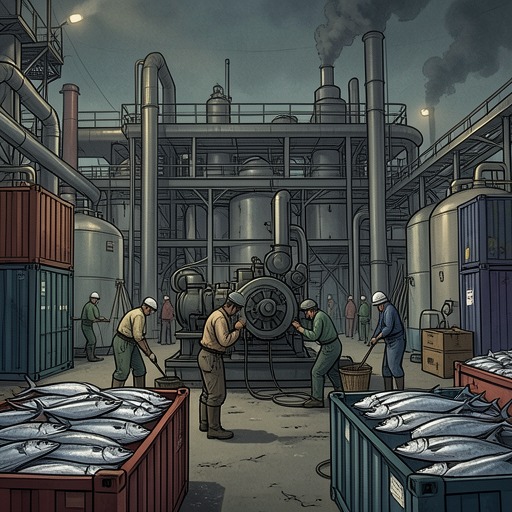
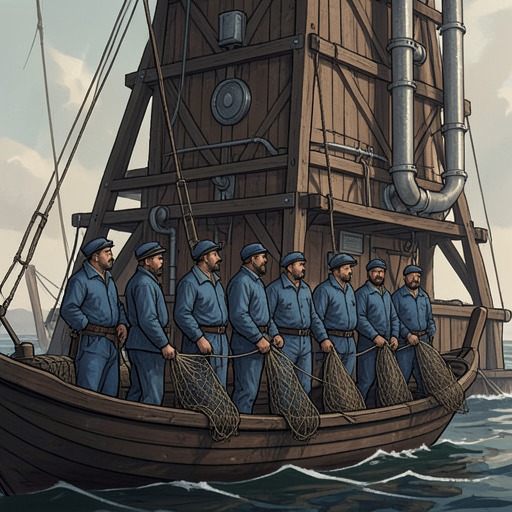
In the spring of 1828, after the Feast of the Holy Crucifixion, Ignazio watches the tuna catch being unloaded following the mattanza. The fish have been taken with harpoons and are brought ashore in sequence. More tuna wait in the bottom of the black boat, destined for the tonnara, where they are hung by the tail for at least two days so that blood and other fluids drain before they are gutted. The scene makes the catch a process rather than a single act: landing is followed by preparation, and the fish’s value depends on organized work at the fishing installation.
The episode situates that work within the wider rhythms of the fish’s life. Tuna are described as peaceful, silvery animals that travel in large shoals, moving from the Atlantic into the Mediterranean in spring to reproduce. When the season and temperature are right, the tonnara is lowered to intercept them. The fishing operation therefore depends on a seasonal passage through the sea, a recurring natural pattern on which people and businesses have built an industry.
The Tonnara and the Florio Business
The catch is managed through the tonnara, and the novel emphasizes the people who make its operation function. During the 1828 scene, Ignazio’s secretary reports that the second netting has also gone well and says he has instructed Alessio to collect payment the next day for himself and the crew. The catch thus entails not only the handling and processing of fish but also coordination and payment for the workers involved.
Over time, tuna fishing becomes one part of a much broader company. The Ignazio and Vincenzo Florio Company trades in spices and colonial goods, holds interests in an insurance company established by Palermo and foreign merchants, and owns shares in steamers and cargo ships. It also manages several tonnare, including those at San Nicolò l’Arena and Vergine Maria, and later takes over the one at Isola delle Femmine. These investments become profitable after lean years, placing the fishery alongside the company’s other commercial activities rather than outside its business structure.
For Vincenzo, however, the Arenella plant stands apart from this list of assets. It is the tonnara that his uncle Ignazio continued to rent even when tuna fishing was in crisis. Ignazio describes that persistence as a matter of love; Vincenzo, in turn, comes to desire the place with an attachment he does not initially recognize. The fishery is therefore at once a commercial undertaking and a site of inherited feeling, linking the younger Florio to the older man’s enduring commitment.
From Catch to Food and Memory
Tuna also appears as food in the domestic world. In a later scene, Giulia asks Vincenzo to help open a can of tuna in brine. The can comes from the Arenella tonnara, which he owns in partnership with Augusto Merle, a half-Frenchman who has settled in Palermo. The preserved fish carries the enterprise into the household: a product of a fishing ground and a commercial partnership is opened and prepared as part of an ordinary meal.
That moment prompts Vincenzo to remember an earlier practice of preservation. The kitchen before him blends with the kitchen at Piano San Giacomo, where he recalls someone taking pieces of fish from an earthenware pot sealed with wax. The juxtaposition connects the later canned product to a remembered household method, setting a new form of commercial preservation beside an older domestic one. Tuna’s significance consequently extends beyond the catch: its movement through different ways of preserving and eating it ties business innovation to family memory.
Significance
Across these episodes, tuna fish gathers together ecological seasonality, organized labor, capital, and domestic life. Its migration makes the catch possible; the tonnara converts that seasonal passage into work and revenue; and the Florio company incorporates fishing grounds into a diversified commercial portfolio. At the same time, Arenella is not simply another profitable holding for Vincenzo. The fishery’s earlier importance to Ignazio and Vincenzo’s own growing attachment give the place an emotional dimension that business accounts alone cannot explain.
The narrative also places tuna among the larger flows of commodities that shape Sicily’s fortunes. The Florios’ business ranges from spices and colonial goods to shipping, insurance, and fishery holdings, while the preserved tuna in the household recalls how commercial goods enter everyday life. Tuna thus marks the point where sea and shore, seasonal nature and human organization, and family memory and enterprise meet.